
Introduction: The Grim Reality of Medieval Justice
When we imagine medieval life, the word “barbaric” often comes to mind—a vague notion of a harsh and unforgiving time. But the reality of its justice system was far from vague. It was a world of calculated, systematic cruelty, where punishments were engineered not merely to penalize a crime but to serve as a terrifying public spectacle. These brutal methods were meant to deter criminals and enforce order through fear.
And yet, despite the threat of unimaginable suffering, people still committed crimes. The existence of these horrific instruments reveals a dark chapter in human history, showcasing a disturbing ingenuity focused on maximizing pain. This article explores five of the most shocking and cruel punishments from Medieval Europe, moving beyond simple execution to reveal a world of meticulously designed agony.
Punishments Designed for Maximum Suffering
The following examples represent some of the most terrifying methods used to inflict pain, humiliation, and a prolonged, agonizing death.
1. The Judas Cradle: Agony by Design
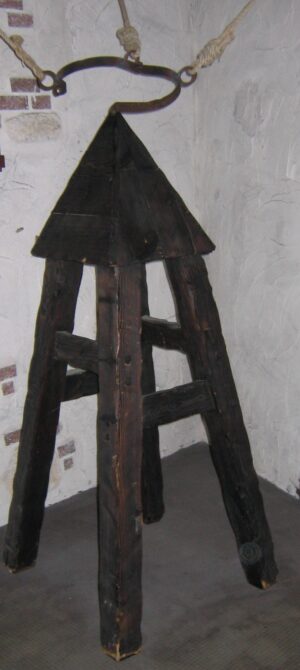
Also known as the Judas Chair, this Italian-designed device was a masterpiece of minimalist cruelty. It consisted of a pyramid-shaped seat upon which a prisoner was slowly lowered using ropes. The sharp point of the pyramid was positioned to enter the victim’s anus or vagina, using their own body weight to create immense pressure.
The outcome was rarely swift. The device was designed to stretch the orifice, causing lasting damage and tearing muscle tissue that would inevitably become infected. To hasten the process and intensify the pain, torturers often added weights to the victim’s legs, which frequently led to a slow, agonizing death by impalement. The true horror of the Judas Cradle lay in its psychological torment, forcing the victim into a state of escalating pain inflicted by the simple force of their own body.
2. Rat Torture: A Weaponized Force of Nature

This method weaponized one of nature’s most basic instincts: the will to survive. The process began with the victim being completely restrained, typically tied to the ground or a flat surface. A rat was then placed on their stomach and covered with a metal container that was slowly heated.
The escalating heat would drive the cornered, terrified animal to seek any possible escape route. The only way out was down. The result was a uniquely gruesome death, as the rat would burrow and claw its way through the victim’s body.
…a rat was put on the stomach and covered with a metal container that was slowly heated. The rats started looking for a way out, which meant it had to go through the body of the victim. It normally took a few hours to dig through the body, which led to a painful and horrible death.
The chilling effectiveness of this torture was its use of a living creature, turning a desperate animal’s survival instinct into a horrific, flesh-rending weapon.
3. The Breaking Wheel: A Public Spectacle of Slow Death
Known as the Catherine Wheel, this device was reserved for brutal public executions. It was typically a large wooden wagon wheel with spokes, to which a condemned criminal was tied, their limbs splayed out. The executioner would then use a heavy iron cudgel to systematically shatter the victim’s arms and legs, striking them through the gaps between the spokes.
What made the breaking wheel so infamous was the prolonged suffering it inflicted. The goal was not a quick death but a drawn-out public display of agony. With their limbs broken and mangled, victims were often left on the wheel to die from shock, dehydration, or their grievous injuries. Worryingly, they could survive in this state for several days, a grim and suffering monument to the consequences of crime.
4. The Pear of Anguish: A Tool of Targeted Cruelty
The Pear of Anguish was a specialized instrument of mutilation designed for specific “crimes.” The device consisted of four metal leaves that, when a screw at the top was turned, slowly and forcefully spread apart. It was deployed by inserting it into one of the victim’s orifices before expansion.
This punishment was explicitly targeted. It was inserted into the vagina for women accused of causing a miscarriage, the anus for gay people, and the mouth for liars and blasphemers, which is why it’s also called the choke pair. While it rarely killed directly, the Pear of Anguish was used to tear skin and inflict catastrophic internal damage, maiming and mutilating the victim in a deeply personal way. It was often employed after other forms of torture had already been administered, adding a final, brutal layer of punishment.
5. Coffin Torture: The Slow Agony of Humiliation
Considered one of the worst forms of torture in the Middle Ages, this method focused as much on psychological degradation as physical suffering. The victim was placed inside a caged coffin, shaped roughly like a human body, which prevented any meaningful movement.
The length of time spent in the coffin depended on the crime; for example, slander was a crime that could lead to death by this method. The coffin was then put on public display, where angry crowds would often mock and hurt the trapped victim. This transformed the punishment from mere confinement into a torturous public spectacle. It was a slow agony of exposure, helplessness, and humiliation, where the torment inflicted by the public was as much a part of the sentence as the cage itself.
Conclusion: The Sobering Ingenuity of Cruelty
These instruments of punishment reveal more than just a tolerance for brutality; they demonstrate a disturbing level of creativity and psychological insight. Each device was engineered not just to end a life, but to dismantle a human being through prolonged physical suffering, public humiliation, and mental anguish. They stand as sobering artifacts of a time when justice was synonymous with terror.
What does the existence of these meticulously designed instruments of pain reveal about the societies that created and used them?